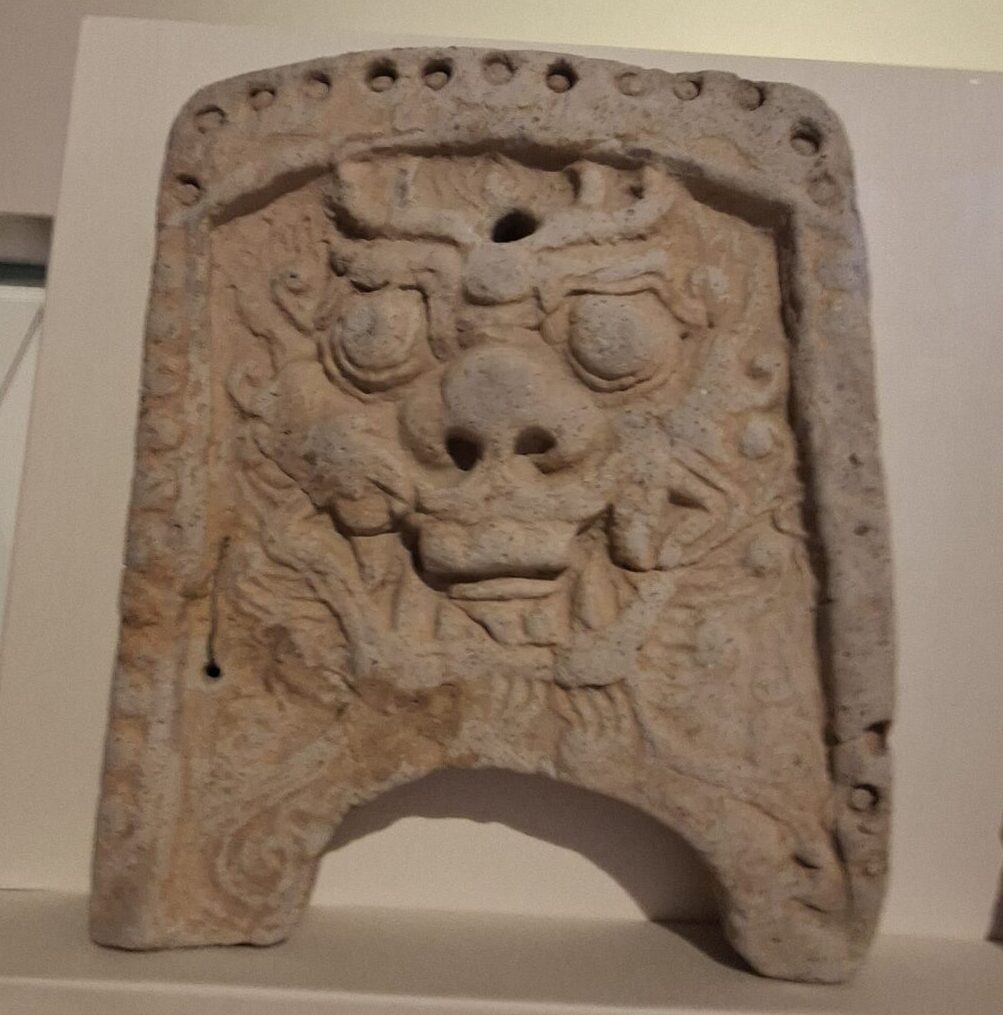
This question came to me when I was in Neil MacGregors A History of the World in 100 Objects I perused the pages. Among the hundred objects selected by the former director of the British Museum, I discovered, precisely, a Korean tile from the Silla Dynasty – as the 49th object. Surprised, I wondered what a British historian wanted to tell with this?
MacGregor It describes the Silla dynasty, which united large parts of the Korean Peninsula in the 7th century, and the political, geographical, and economic situation of Korea between powerful neighbors. Silla allied with the Chinese Tang Dynasty to defeat its rivals. However, after the victories, Tang attempted to extend its influence over Korea. Silla resisted Tang influence – and since then Korea has struggled to maintain its independence.
We Koreans learn in school that Korea has its own language, history, and cultural identity. Korea is neither China nor Japan. I grew up with this sense of history. But this tile gives me a special sense of presence. It is not a royal sword, nor a precious crown: it is burnt clay. It tells of an empire that asserted its position between powerful neighbors. But MacGregor he recognized more in it.
The roof tile bears a face. It looks evil, almost terrifying. Such faces are meant to ward off evil and protect the building. In its protective function, the face somewhat resembles the water sprites of European churches. However, it belongs to a distinct Korean visual tradition.
From this I read: vigilance. Being vigilant to protect oneself. Being vigilant to not lose one’s own identity. Perhaps this thought concerns me because Korea’s history has often been shaped by the question of how a country can remain independent amidst powerful neighbors. That didn’t always work out well.
The Japanese colonial rule from 1910 to 1945 is one of the most painful chapters in our history. It shows that independence is not a given.
MacGregor shows the line from the roof tile to the semiconductors. He writes in his book: Anyone who uses a mobile phone today, drives a car, or buys a new television has a good chance of holding a product or an important component thereof that originates from Korea. Samsung, Hyundai, LG. Korean technology is present in our everyday lives everywhere. For many Europeans, Korea only seems to have arrived on the world stage with these companies. But Korea is not new. Korea is becoming part of everyday life around the world.
This thought wouldn’t leave me alone. Back then it was a roof tile; today it’s a semiconductor. Both are products that are produced in large quantities. Of course, there are centuries of technological development between them. But I am interested in another connection: the ability to translate knowledge into something that plays a role in the daily lives of many people.
Korea has a long history of technological innovation. The Koreans already used movable metal letters, Before Gutenberg developed movable metal type printing in Europe. And yet, Korea has learned a lot from other countries in the modern era. Especially from Europe. Europe has shaped scientific and industrial developments over the centuries. Europe has shaped scientific and industrial developments over the centuries. Korea adopted technologies, learned from them, further developed them, and built up its own industrial capabilities.
In that I see no contradiction to independence. On the contrary. Those who learn from others do not remain dependent.
Learning doesn't just mean taking on responsibility
In my work between Korea and Europe, I keep encountering a question: What happens when a company adopts a technology but doesn’t understand the underlying thinking? Korean companies don’t just want to buy technology; they want to understand how it works, implement it in their own country, and develop it further..
But how much knowledge is actually transferred? A machine can be bought. A process can be documented. But technology is not just about machines, drawings, patents, or processes. It also involves people. People who recognize problems in a certain way, make decisions, weigh risks, investigate errors, and share knowledge.
For me, knowledge transfer therefore has four levels: the technology, the process, the decision-making patterns, and the ability to learn from them further. Only when these levels come together can self-empowerment arise from adopted technology.
European and Korean companies often develop different approaches in this regard. What is natural for one side seems cumbersome, slow, or incomprehensible to the other. One side asks why decisions are not made faster. The other side wants to first understand whether all prerequisites are met. Both want to be successful, but they do not always understand why the other side acts in this way. Practical example from my work: contractual penalty
For me, this is the challenge of international cooperation. It is not enough to adopt the technology of others. One must also want to understand how this knowledge came about. And that applies to both sides. Koreans do not need to think in a European way. Europeans do not have to think like Koreans. But both should be able to understand the mindset of the other in order to move forward together.
Something Third is emerging on the way to the center
I thought about it for a long time, what good cooperation is means. Is it a compromise? Does one side have to adjust to the other? I don't think so. Good teams find a middle ground. And that middle ground is not a fixed point. It changes as people work together, learn from each other, disagree, try things out, and start over again.
Both sides bring their own experiences, skills, and ways of thinking. They do not have to give up these things. But if they are willing to see the world from the other side, something can emerge that previously had no side to it alone.. Something Third. In that I see creativity. And in that lies the power of collective innovation for me. Perhaps being vigilant today means preserving one's own independence without being closed off to the new.
When I traveled to London this autumn, I wanted to see this tile in the British Museum. I had first discovered it in a book. After that, I saw it that has accompanied me mentally for many centuries. From Silla and Tang to the history of Korea, semiconductors, technology, and the cooperation between Korea and Europe. Now I stood in front of a small piece of burnt clay. It didn’t seem to me like something that had lain dormant in the past for more than a thousand years. There was something alive about it. I looked at it. And that face! Wild. Bold. Vital. And I had to smile.
You can find the practical example presented here under „Intercultural Service“.“: Collaboration in international teams. Profit You will benefit from interactive and exciting practical knowledge from the international working world. We help you to operate effectively in intercultural environments.
Book your appointment online now and start your journey to successful leadership and collaboration in one of Asia's most dynamic markets!
South Korean groups record split industry development in 2025 (GATI)While the technology sector, in particular semiconductor companies such as Samsung Electronics and SK Hynix, are providing strong growth impetus, traditional export industries such as automotive, chemicals and mechanical engineering are seeing declines or stagnation
Frequently asked questions about Korea Business: Is there a work-life balance in South Korea? And how did Koreans go from being „fast followers“ to „first movers“ after the Korean War (1950-1953)? What role does the Confucian hierarchy play in setting the tone in everyday working life? Furthermore, how do Koreans resort to the „human revolution“ to optimize their living situation?
This YouTube movie provides the answer to not mincing words. How to be successful in South Korea: cosmetic surgery to impress the boss
Wild. Bold. Vital. I have to see this face for myself! That was the question I asked myself when I...
„An-nyoung-ha-se-jo“ or „Good day“ Intercultural communication in international business Whether a French HR manager leads the German team in the USA...
Careers with Korean corporations in the DACH region 10 things German, Swiss and Austrian managers should know beforehand Why „only...
The Future Female Leader 1. power and identity Power without harshness, how female leaders use power confidently. Between Korea, Germany...